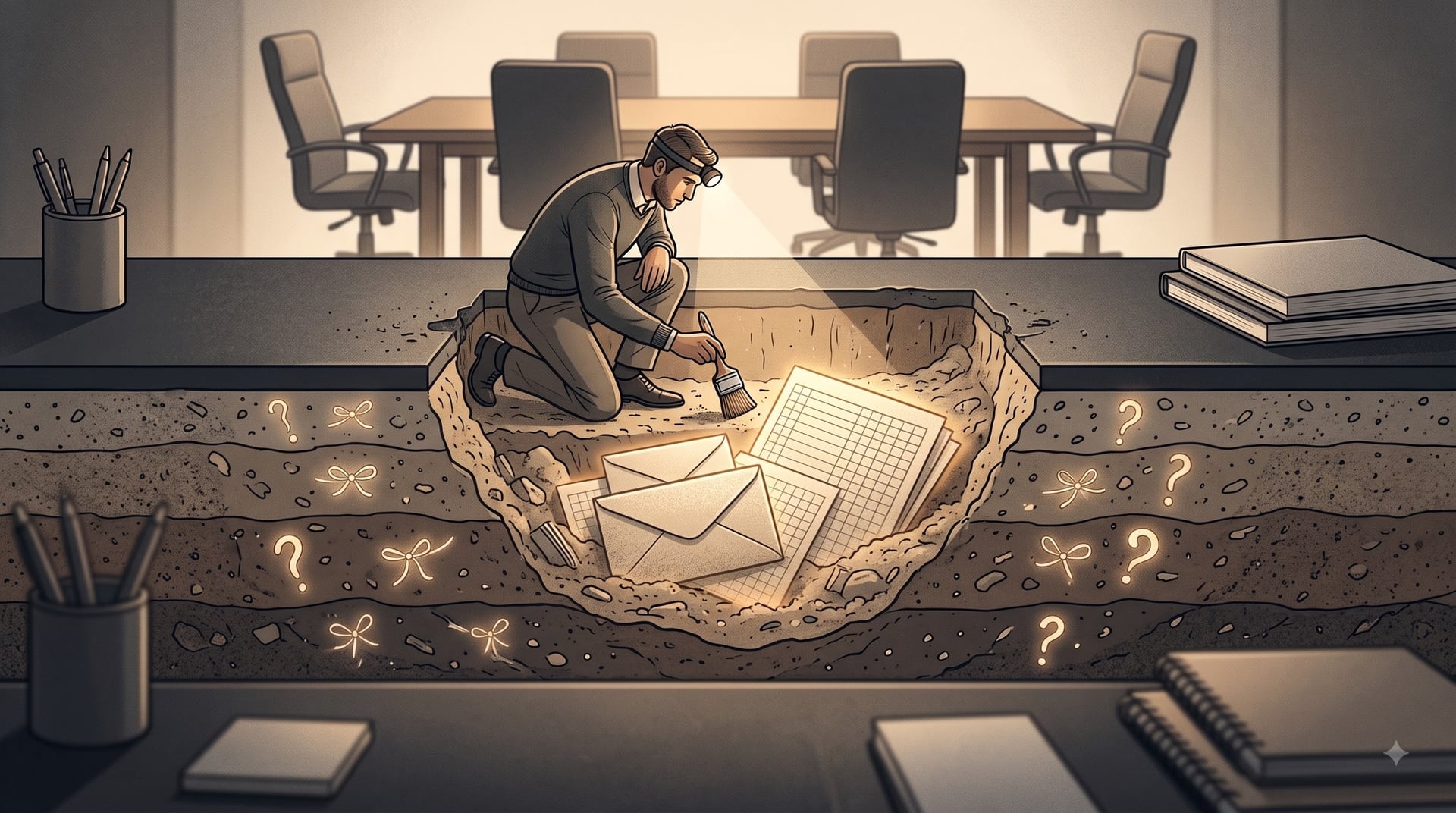
The quarterly review is on Thursday. On Tuesday night somebody opens a blank deck, then opens Gmail, and begins scrolling backward through five months of threads trying to remember what was agreed in April. Two hours later there is a slide titled Progress with four bullets on it. Three are things the client already knows, and one is slightly wrong.
This is why QBRs get dropped from the calendar. Nobody doubts their value. Preparing one costs half a day of archaeology, that cost falls on the busiest person you have, and it falls again every quarter for every account.
Why do QBRs get postponed?
Look at which ones slip and the pattern is unpleasant. QBRs get postponed for the accounts where prep is hardest, and prep is hardest where the history is longest, most tangled, and most contested. So the review is skipped where the relationship is most complicated, which is where a review would have helped. The newer accounts with three months of tidy history get reviewed on schedule and did not especially need it.
There is a second failure mode that looks like success. The meeting happens, on time, and it is a status update. Here is what we delivered, here are some numbers, any questions. Everyone is polite, it takes forty minutes, and nothing is learned. That version is cheaper to prepare, which is why teams drift toward it, and it is close to worthless because the client already knew what you delivered.
What a QBR is for
A QBR is a renewal conversation held early enough to still change the outcome. Months before anyone has to decide, you are trying to surface what is not working, what has changed on their side, and what they have stopped asking you for. A well-run review is mildly uncomfortable at least once, because the useful information in it is the part the client has not volunteered.
That reframing changes the prep completely. If the meeting is a status update, prep means assembling accomplishments. If the meeting is an early renewal conversation, prep means assembling evidence about the health of the relationship. Most of that evidence is sitting in the mail rather than in any dashboard.
The five questions your prep has to answer
- What did we promise this quarter, and did it land on time? The list of what we delivered is the flattering version. The question is what we said we would do, including the small things said in passing, and what happened to each one.
- What did they ask that we never properly answered? Questions buried in paragraph three of a message mostly about something else, in a thread that looks handled because it got a reply. These are the most dangerous items on the list and the hardest to find.
- What changed on their side? New people on threads, old people gone quiet, a shift in who is CCed, a procurement address appearing for the first time. Personnel changes on the client side precede strategy changes on the client side.
- Has the rhythm changed? Compare this quarter's contact frequency to the relationship's own normal. A client who used to write twice a week and now writes once a fortnight has told you something already, in the only language that never lies.
- What did they say no to, and is it still no? Every account carries a graveyard of declined proposals. Some were declined on timing rather than merit, and the timing has moved. This is where expansion comes from, and almost nobody tracks it.
Answer those five and the deck writes itself. Notice also where the answers are. A CRM holds the contract value, a project tool shows what shipped, and a support dashboard reports how fast tickets closed. None of them holds a promise made in passing, a question that went unanswered, or a client who went quiet. All five of those live in email, which is what Sektra reads.
Sourcing the answers from the inbox
The manual version is a two-hour job per account. Do it once, on your most important client, to see what turns up. Filter the mailbox to that domain for the quarter. Read your sent mail before theirs, because that is where your promises live and where the gap between intention and delivery is visible.
Write down every commitment with a date. Then read their inbound looking for question marks, and check each one against your replies. Finally, sort the whole thread list by date and look at the gaps rather than the messages.
Teams that do this for the first time are usually startled twice. Once by the number of small promises made in a quarter, which typically runs into the dozens per account against a handful anyone can recall. And once by finding at least one client question that was never answered by anybody, sitting in a thread that everyone considered closed.
The structural version removes the two hours rather than shortening them, which is why we built Sektra the way we did. Because it reads the team's Gmail continuously, four of the five answers are already maintained per client before anyone schedules the meeting.
It holds every commitment in both directions, with what landed and what slipped. It holds every client question still open, including the ones inside threads that already got a reply. It tracks the changing cast of people on the threads. A watch on the account alerts you the day the client has been quiet longer than you set. QBR prep stops being a reconstruction project and becomes a read.
The fifth answer, the graveyard of things they declined, is the one you ask for. That is what the assistant is for. What did we propose to them last year that they turned down, what were the reasons, who objected. These are the questions you would put to a colleague who had been on the account for years, except this one has read every thread.
Prep that used to consume a Tuesday evening per account becomes something you can do properly for every account in the book. That is the unlock, because the reviews that get skipped are never the easy ones.
A QBR agenda that follows from the prep
Forty-five minutes, and the order matters more than the content. Put the uncomfortable material early, while there is still time to do something with it.
- Five minutes: commitments, both directions, including the ones you missed. Naming your own misses first is the most effective thing in the meeting, because it makes the rest of the conversation candid.
- Ten minutes: the open questions you found, answered. Turn the archaeology into visible value rather than confessing to it.
- Ten minutes: what has changed on their side. Ask directly about the people who have appeared and disappeared from threads. This is where you learn about reorganizations, budget cycles, and the new VP with opinions.
- Ten minutes: the graveyard. Raise one or two things they declined earlier and ask whether the reasoning still holds. Expansion, when it comes, usually comes from here rather than from a new pitch.
- Ten minutes: commitments for next quarter, written down in the meeting, in both directions. Include what you need from them, which most teams are too polite to state and then resent later.
There is no long recap of work delivered. If they need to be told what you did, the problem is not solvable in a QBR.
The follow-up email is the real deliverable
Within a day, send a short message listing exactly what was agreed, who owns each item, and by when, including their items. Treat it as a ledger rather than a thank-you note. It converts a conversation into something checkable. It puts their obligations in writing where they can be referenced without friction. And it becomes next quarter's prep, since the first question of the next QBR is what happened to this list.
Run this loop four times and something changes in the relationship. The review stops being a performance where you demonstrate value and becomes the mechanism by which the account is managed. Which was always the point, and the only thing standing in the way was the four hours of scrolling.