A quarterly business review template has four parts. A 45-minute agenda with minutes per block, eight slides, a pre-read sent 48 hours ahead, and the questions you will ask. The template below covers all four, with worked examples and the mistakes to avoid. A downloadable copy lives at /tools/qbr-template.
Run the QBR in 45 minutes. Commitments both ways (5), open questions answered (10), what changed on their side (10), earlier proposals they turned down (10), next quarter's commitments written in the meeting (10). Eight slides, no more. Send a two-page pre-read 48 hours ahead. The agenda, slide outline and checklist are at /tools/qbr-template.
What does QBR mean?
QBR stands for quarterly business review. It is a scheduled meeting between a supplier and a client, held once a quarter, to review what was delivered, what it achieved, and what happens next. In account management and customer success it is the main structured conversation with a client outside the day-to-day work.
The format comes from internal management reviews, where a business unit presents its quarter to leadership. Vendor teams adopted it to show value well before a renewal. An executive business review (EBR) is the same meeting pitched one level up, with the client's sponsor in the room and the operational detail left out.
The word review undersells it. A good QBR is the renewal conversation held early enough to still change the outcome. It is where the client says what has stopped working, what changed on their side, and what they want from you next. There is still a quarter to act on it.
What should a quarterly business review template include?
Four things, and they depend on each other. The agenda decides how the time is spent. The slides give the agenda something to point at. The pre-read moves the reporting out of the meeting so the meeting can be a conversation. The question list stops you presenting for 45 minutes and calling it a review.
Leave out any one of the four and the others sag. Without a pre-read the slides fill with numbers. Without a question list the agenda runs as a monologue.
The 45-minute QBR agenda
Order matters more than content. The uncomfortable material goes first, while there is time left to do something about it, and the forward-looking material goes last so the meeting ends on a decision.
| Block | Minutes | Who leads | What comes out |
|---|---|---|---|
| Commitments, both directions | 5 | You | A list of what each side promised last quarter and what landed, with your misses named first |
| Open questions, answered | 10 | You | Answers to the questions the client asked over the quarter that never got a full reply |
| What changed on their side | 10 | The client | New people, departures, budget cycles, priorities that moved |
| What they turned down, revisited | 10 | You, then the client | One or two earlier proposals they declined, and whether the reason still holds |
| Commitments for next quarter | 10 | Both | A written list of what you will do and what you need from them, with dates, agreed in the room |
That adds up to 45 minutes with no slack, which is the point. Book an hour and keep the agenda at 45, so there is room for what the client brings up. If a block runs long, protect the first and the last; they cannot be done by email afterward.
The eight slides and what goes on each
Eight slides is a ceiling. A QBR presentation that runs to twenty slides is a status report with a cover page. Each slide carries one idea and one table or chart, and the numbers on it were already in the pre-read, so you point at them and move on.
| Slide | Title | What goes on it |
|---|---|---|
| 1 | Where we stand | One sentence on the state of the relationship, in your words, that you would be comfortable having quoted back |
| 2 | What we promised and what landed | Last quarter's commitments in both directions, each marked done, late or missed, with the misses on your side at the top |
| 3 | Your questions, answered | Three to five client questions from the quarter that deserved a fuller answer than they got, with the answers |
| 4 | Results against the goals we set | The two or three measures agreed at the last review, with the agreed target next to the actual |
| 5 | What changed on your side | The names, roles and priorities you believe changed, written as a prompt for the client to correct |
| 6 | Things we proposed before | One or two declined proposals with the original reason for the no, to reopen the discussion |
| 7 | Risks and what we would do about them | Anything that could hurt the account in the next quarter, including things that are your fault |
| 8 | Next quarter, both directions | The commitments agreed in the meeting, filled in live, with owners and dates |
Slide 8 is blank when the meeting starts. Filling it in the room, on screen, is what turns the agenda's last block into a commitment both sides watched being written down. Send the completed slide the same day.
The pre-read checklist
The pre-read goes out 48 hours before the meeting, as a two-page PDF or a short document. It carries everything the client would otherwise spend meeting time reading. Working through it is also the preparation itself. By the time the pre-read is written, the meeting is ready.
- Every commitment made last quarter, in both directions, with its date and status. Read your own sent mail first, because that is where your promises are.
- Every question the client asked that did not get a full answer, pulled from the threads, with a one-line answer drafted for each.
- Results against the measures agreed at the last review, with the agreed targets, so nobody has to remember what good looked like.
- The people who appeared on or disappeared from threads this quarter, with their roles as far as you know them.
- Response times for the quarter on your side, if you track them, stated plainly even when they are worse than the quarter before.
- The one or two earlier proposals you want to reopen, with the reason they were declined at the time.
- A draft of slide 7, the risks, written before you talk to the client so their answers do not soften it.
- The agenda itself, with the minutes, so the client knows the meeting will run to time.
The questions to ask
A review where you did all the talking was a presentation. These questions are the ones the client will not volunteer, so you have to ask them.
- Which of our misses this quarter caused you the most trouble, and how did you work around it?
- What has changed in your team or your budget since we last sat down that we should know about?
- Who on your side do we not talk to that we should?
- What did you ask us for this quarter that you are still waiting on?
- When you declined the proposal in the spring, the reason was timing. Has the timing moved?
- If you had to defend our contract to your finance team next month, which number would you point at?
- What would make you not renew?
Quarterly business review examples
The agenda holds across sectors, and the content of each block changes.
An agency reviewing a retainer client puts campaign results on slide 4 and the scope creep of the quarter on slide 7. The declined proposal on slide 6 is the content calendar the client said no to in February, now that their own hire has left. Commitments for next quarter include the approvals the client owes, with dates, because late approvals caused two of the agency's three misses.
A customer success manager reviewing a software account leads with adoption on slide 4, measured against the usage targets set at onboarding. Slide 5 asks about the new head of operations who started copying herself on tickets. Slide 6 revisits the integration the client declined at signing. Slide 7 names the champion risk out loud: the person who bought the product is moving teams.
A consulting firm reviewing an advisory engagement puts the recommendations delivered and the ones the client acted on side by side on slide 2. It tends to be the most uncomfortable slide in the deck. Slide 3 answers the three questions a partner was asked at the last steering meeting and promised to come back on.
Mistakes that turn a QBR into a status update
- Presenting what you delivered. The client already knows. Slide 2 is about what you promised, which is a different list.
- Leaving your misses off the deck. The client noticed them, and naming them first is what makes the rest of the meeting candid.
- Putting the numbers in the meeting when they belong in the pre-read. Forty minutes of reading charts aloud leaves five minutes for the conversation.
- Letting slide 8 stay empty. If next quarter's commitments are agreed by email afterward, half of them will not be.
- Booking it only for the easy accounts. The reviews that slip are the ones for the accounts with the longest, most tangled history, which are the accounts that needed one.
- Treating slide 6 as a pitch. It reopens an earlier conversation. The expansion comes later, if the reason for the earlier no has gone.
Preparing the QBR from the inbox
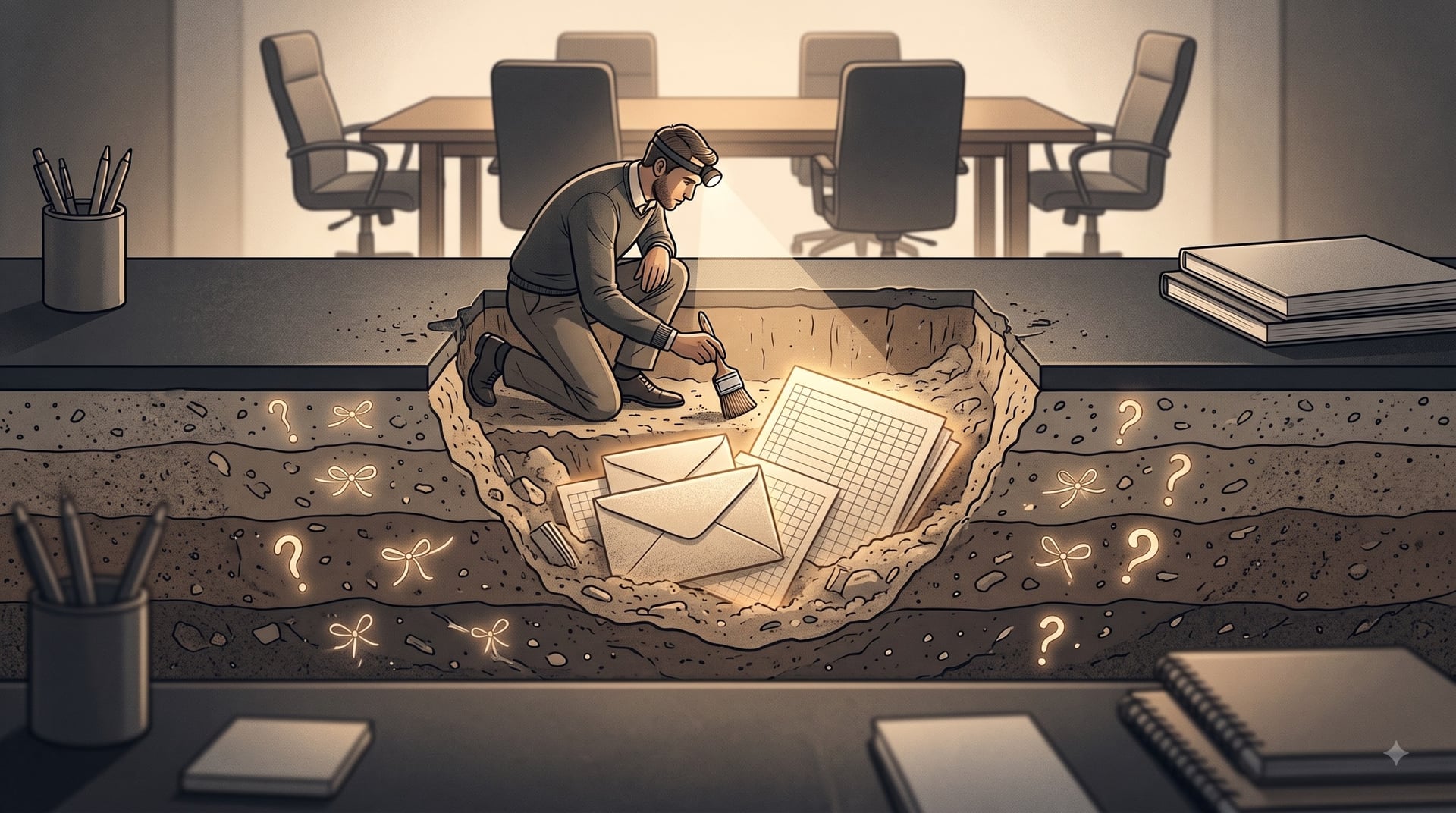
Almost everything on the pre-read checklist lives in email. The promises are in sent mail, the unanswered questions in paragraph three of a thread that looks handled, the new names in the CC line. Reconstructing a quarter from a Gmail or Outlook mailbox takes an afternoon per account, which is why reviews get postponed for the accounts that need them. The earlier post on running a QBR from your inbox walks through the manual version.
We build Sektra, a shared inbox that syncs with Gmail, Outlook, IMAP and WhatsApp Business and keeps a record per client. The memory layer is the part of Sektra that reads every thread and tracks commitments, open questions and people for each client. It holds the first four items on the pre-read checklist before anyone schedules the meeting.
Lens, the panel beside any thread, shows that record for the client you are looking at. What you promised and whether it landed, what they asked that is still open, who has appeared on their side. Analytics give the response times for the pre-read as a median and a p90 for that client, so the number on the slide is the number the client felt.
For slide 6, ask the assistant what you proposed last year that they turned down, and it answers with links to the threads. The pre-read takes twenty minutes instead of an afternoon. Account management and customer success teams use the same record for the week-to-week work between reviews. The product page covers how the pieces fit.
Download the QBR template
The downloadable version at /tools/qbr-template has the agenda with minutes, the eight-slide outline, the pre-read checklist and the question list. Copy it into Google Docs, Word or your deck tool. Use it as written for the first two reviews, then cut what your clients do not respond to. The order of the blocks is the part to keep. The content of each block is yours.
A QBR is the cheapest renewal conversation you will ever have, because it happens while the answer can still change.